Tampilkan postingan dengan label Technology. Tampilkan semua postingan

Senin, 22 September 2014

NueMD Launches A Survey Relative to HIPAA Compliance and Readiness

NueMD is conducting a survey of healthcare professionals to gauge their knowledge of HIPAA and help them prepare for an audit.   NueMD is one of the valued sponsors at the Medical Quack so please when you have a moment be sure to take look at the right hand side and see what all have to offer.  Advertisers help keep this blog going.   I also have a link at the bottom of the site with additional information located at the NueMD website.   Nobody ever looks  forward to a HIPAA audit but it’s better to be prepared than to be caught short by all means.  BD 

Click Here To Take the Survey


NueMD is conducting a survey of medical practices, billing companies, and business associates about HIPAA compliance.

In anticipation of the upcoming audits by the Office of Civil Rights, researchers at NueMD have teamed up with The Daniel Brown Law Group and Porter Research to conduct a survey that will help small practices prepare for an audit.

The survey will gauge respondents’ knowledge of HIPAA’s Privacy and Security regulations, understanding of compliance measures, and how electronic devices are used for communication.

Participation is strongly encouraged for care providers, office managers, and office staff of medical practices, as well as those who work for business associates (medical billing companies, software companies, etc) of covered entities.

“Our goal with this survey is to understand how knowledgeable small practices are about HIPAA regulations and what they’re doing to prepare for an audit,” said Caleb Clarke, director of strategic development at NueMD. “The results of the survey will also allow practices to benchmark their progress against their peers and learn what areas may require additional attention.”

All responses are anonymous, and instructions on how to access the results will be provided upon completion of the survey.

http://www.nuemd.com/blog/nuemd-launches-survey-hipaa-compliance-ahead-audits

Emerge.MD to Delivery Video Enhanced Telehealth Using Polycom Real Presence Solution

Polycom is about as top level as you can get with quality video and has been around for a long time.  The companyimage has partnered with Microsoft and may others over the years and now Emerge.MD is using the platform for telehealth.  It can be used to engage the patient, other doctors and so on.   The video below is a statement from a hospital’s success with the program. 

As we all know rural hospitals are really in dire need of telehealth.  Two or more physicians can connect to collaborate.  Also doctors can connect with patients at home, all with a face to face consultation.  BD 

From the website:

“With a web browser and a simple web camera, Emerge.MD can plug patients in to a telehealth care network. Chronic disease monitoring devices are made all the more effective when providers can directly contact a patient when they notice a change in their health status, and follow-up with a face-to-face consultation that adheres to federal privacy laws.”

The video below gives an example of Consult Accelerator and an explanation of how it works.  BD 


PHOENIX, AZ, Sep 22, 2014 (Marketwired via COMTEX) -- Emerge.MD, the only telehealth cloud platform that can connect all the people, processes and technology involved in virtual care with a high degree of security, today announced its products have been demonstrated to interoperate with solutions from Polycom, Inc. PLCM, -2.23% a global leader in video, voice and content collaboration solutions.

Emerge.MD is now integrated with Polycom's RealPresence Platform, which creates a seamless user interface for healthcare organizations to take advantage of video-enhanced workflows when engaging with patients and other healthcare professionals.

http://www.marketwatch.com/story/emergemd-to-deliver-video-enhanced-telehealth-polycom-ready-solution-to-enhance-patient-care-2014-09-22

Minggu, 21 September 2014

Antiquated Ways Hospitals Report Cost to Medicare “Really Distorts” The True Cost of Care–New Model Please..

Here we go again with the same discussion of antiquated models with way too much math and quantitation.  This is a discussion with several hospitals in the Ohio area as the are talking about the future of hospitals and yet still have the noose around their necks with the government on quality reporting and cost.  We all know HHS and CMS are dealing with outdated models and it’s making everyone nuts.  In addition you have health insurers flipping back and forth on contracts, what they cover, what they don’t cover, what changes today, what won’t be there tomorrow and so forth. image People are absolutely hating this complexity that has been created just to go get care.  Look at the link below, some hospitals can’t eve get the ER doctor groups and the hospital itself with the same insurers, so people get screwed again on balance bills. 

In Texas Hospitals Having Issues Employing In-Network Doctors With United Healthcare & Humana-Found One Insurer Still Listing An In-Network “Dead Doctor”…

The article mentions that delivery of care has changed in healthcare and that is true but you’re never going to get away from having hospitals who do have a certain amount of fixed costs that can’t go away either.  Hospitals are anticipating a decrease in the demand for care due to both preventive care and other technologies, perhaps like telehealth that will ease a little on expense.  The one big bogus item we have seen for years though is the projected savings brought by technology and in fact it’s just the opposite as all of it costs money, even if there’s fewer patients being seen at a hospital. 

In the group here is also the Cleveland Clinic and basically they are all saying “we don’t know what’s going to happen” down the road and we don’t know how to measure the quality consistently with all the constant changes.  They agree on one thing, risk is ever so present.  In California , the CMA is telling United Healthcare their Premium Ratings for Doctors are flawed, so there you go again, but as we all know United thinks you can quantitate everything and that is exactly why some of their models and the ones they helped CMS with are failing. 

United “Quantitated” California Doctor Premium Designation Ratings For Consumers, A Few Minor Changes-CMA Still of Opinion Ratings Cause Harm to MDs and Patients With Inaccurate Designations and Flaws…

Here’s yet another example of the United quantitation extremes…how can this push-pull work?  Sure there’s obvious workflow predictabilities that are helpful with monitoring disease and care and but again we have read like below about projected savings they state in a proof of concept that never arrive as models expand beyond efficiencies and dive to deep into a non linear type of projection. 

United Healthcare Wants to Expand Predictive Modeling for Medicare and Medicaid–Billions in Savings Predicted in Report Only As Good as the Day It Is Published

We are still seeing rural hospitals running out of money and closing up.  In the rural area of Virginia here they had to rely on the free clinic from Remote Area Medical to help them as their hospital closed and doctors are struggling in the area. 

Remote Area Medical Sets Up At Lee County Airport in Virginia For a Free Clinic–Rural Community Needing Care Where The Hospital Has Closed and Doctors Struggle…

Again, the “scoring” and reporting from hospitals on non relevant data could certainly ease up a bit and CMS take a hard look at what data they “really” need as this push and pull with outdated models is going to drive everyone nuts.  As you can read below the hospitals can’t predict and they too say the government tracking is not a true indication of their services so a new more flexible model just might be in order.  BD 


Health care providers expect to see fewer patients in the future as care, technology and access to treatment improve.
That means less revenue for hospitals — collectively, the country’s largest employers — which find themselves operating in a dramatically changing industry.

“The United States is going through the biggest change in its society, probably since the New Deal, affecting the biggest industry in the United States and affecting 100% of the population,” said Dr. Delos M. “Toby” Cosgrove, president and CEO of the Cleveland Clinic. “And as we do that, we recognize that we have to change the delivery system to go to value, increasing in quality and making care affordable. And that is driving change in a very, very big industry.”

Boutros said the health care industry is undergoing a metamorphosis as hospitals transition from sick care to a more holistic approach based in preventive care, which is creating as many uncertainties as potential opportunities in the delivery of care.

“This whole change from a sick-care model to a well-care model — as you know Akron General has been talking about this for over 20 years — we spent $110 million on that concept. As a doc, I really don’t understand how people are going to judge our individual practitioners in a value-based world,” Stover said. “That sort of calculus of how it’s all going to work out is something I think we’re all struggling with.”

The reasons costs are so high to patients, and vary so greatly between hospitals, range from the difficulty of assigning a value to services, Stover said, to a hospital’s costs for research and staff education. Meanwhile, Zenty pointed out, the antiquated way costs are reported to Medicare “really distorts” the true cost of care.

And as hospitals see fewer patients, Zenty said, the result is a “decrease in demand and an increase in supply.” That spells bad news for hospitals that receive a large portion of their revenue from the federal government in the form of Medicare and Medicaid, which is expected to be cut next year, Zenty said.

http://www.crainscleveland.com/article/20140919/FREE/140919741/hospital-leaders-come-together

One More Reason to License Data Sellers–Income Tax Fraud On the Rise-Who Are You Buying Your Data From And Who’s Buying Your Data? 60 Minutes Report

If you read here often enough then you know about the campaign about data selling and the campaign to license data sellers.  We imagedon’t like this as consumers as the data gets flawed and removes our dignity.  60 Minutes has a good report on Income Tax Fraud and when companies are buying data, where is the data coming from?  This is turning the story around a bit but how much gets recycled?  We don’t know.

They did a good job in covering Miami to where it runs wild.  I just did a post on a hospital that had their third data breach in 2 years and it’s all inside jobs with people selling patient data for money.  It’s scary as the former data seller and IRS tax filer tells how easy it is as “people need the money”. 

Hospital in Florida Reports Third Data Breach In Two Years…

This also shows how far behind the IRS is with their data systems and not matching up W-2 forms and 1099, the fraudsters can just make them up.  In addition UMPC Medical Center was hit with this type of  scam, again people selling the data as they need the money.  In Pittsburgh they also have the mayor filing a lawsuit to get the tax exempt status away from the hospital as they make more profits than any other in the US.  Employees had their bank accounts drained as well as tax returns filed.

It goes on further, even US Attorney General was hit, Eric Holder and someone filed a tax return on his social security.  This can start at the low end but people take data and re-package us over and over and over.  Look at the hassle the innocent people have to go through with all of this.  People have lost businesses and other things in life they need.

UPMC Medical Center Workers Protesting Low Wages While Investigation of Employee Data Breach Continues With Fake Tax Returns and Bank Accounts Drained..Double Whammy

I’m waiting for the next crisis to hit with people that purchased their health insurance through Healthcare.Gov to get hit with this when it comes to verifying income with the IRS, will they lose their subsidies?  You do have to remember that the IRS and many other government agencies still work with COBOL and sufficient middleware is needed to allow data to flow back and forth.  At this point you wonder, why did the government create this model?  It was data novices’ with a “wish list” in control and having novices in charge is getting more dangerous in government every day. 

Again this story is about a low level type of data theft but all the data gets recirculated at some point, and what about the Data brokers selling public records?  How’s this going to continue to cause havoc for consumers? 

Pay attention also to the prepaid credit card connection here as well and how the fraudsters work it. 

Again the data business needs a big clean up as data selling is a runaway train.  Medicare payments come via prepaid credit cards.  The IRS can’t tell the difference at times.  With requiring licensing for data sellers again this would give law enforcement yet another leg to stand on with finding and convicting such fraud. 

Even those who do buy and sell data are at risk of getting “hot and stolen data” so again, data licensing and distributing should be licensed.  Here’s another case of stolen data traded and sold right in the open on the internet.

Medical Records For Sale Found On the Black Market - Evolution Market Where Narcotics And Stolen Financial Data Is Openly Traded and Sold…

http://www.cbsnews.com/news/irs-scam-identity-tax-refund-fraud-60-minutes/

Sabtu, 20 September 2014

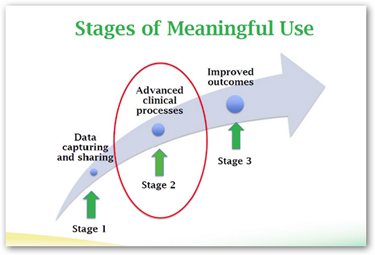
House Bill Introduced Would Shorten Meaningful Use to a 90 Period Instead of a Full Year in 2015–A Model In Desperate Need Of Repair or Revisions…

Let’s hope this get some action as the momentum after a successful Meaningful Use Stage One is beginning to fall off.  Some have told me they have just about given up.  Technology is to blame for some of this and frankly the ONC is overwhelmed with complexities due to some of that along with other things happening in the industry.  90 days is a much more reasonable amount of time as hospitals and doctors are very busy today with a lot on their plates.

One hospital in Arkansas received an audit and is asked to return $900,000 based on the fact that they didimage not do a risk assessment for their Meaningful Use Stage one incentives.  There could be more of these.  They were one of the very early adapters and are planning to write an appeal. 

In addition there was the hardship extension which is throwing a bit of confusion out there with again the versions of meaningful use and software used.   It was confusing and I think some didn’t think they needed it when in fact they may have.  In just the simple summaries I write here it’s an effort to keep up on all the rules and regulations.  Hospitals can use the 2011 Edition certified EHR technology or a combination of 2011 and 2014 Edition certified EHR technology for the 2014 reporting period.  Doctors can attest under the 2013 reporting year and use the clinical quality measures from 2013 and will not get a penalty for not moving to meaningful sue Stage 2 during 2014, ok so did you get all that?

Doctors using older medical record systems have until October 1st to report.   For those that miss a 1% reduction in Medicare payments will be assessed.  I have heard a couple of doctors tell me, it’s easier that way to take the 1% hit but for hospitals, that could add up to big money.  Less than 4% are certified for meaningful use two so far and doctors are at 1.3 percent, so sounds like there’s a few handing in the towel here and taking the hit on the payments.  Hospitals on the other hand are working to get this done by the end of the month to start collecting data.

This just grew to be way too complex after Stage One and again it’s another distraction, with big money attached that takes away from caring for patients.  Stage One was a big success and the rules were pretty clear.  Will there be a stage three, time will tell but I think everyone is tired of Stage Two and wants to move forward and get it out of the way.  This is not how things started with the entire program but as it progressed, a real big mess with CMS and technology entering in here just blew the models out of the sockets and they are not working too well right now.   It’s a mess to even sort out at the ONC I would think as there’s a lot to working with models that have variables that change very frequently and as we see here, they can fail very quickly as well.   BD 


Doctors and hospitals hoping the US Department of Health and Human Services will amend its 2015 reporting requirements for Electronic Health Records may get help in the form of legislation.

Rep. Renee Ellmers (R-NC) this week introduced HR 5481, “The Flexibility in Health IT Reporting Act of 2014.” The bill would reverse HHS’s decision to keep a full-year reporting period for its EHR incentive in 2015, replacing it with a 90-day reporting period. Providers have asked for asked for a shorter reporting period because they say the vast majority of doctors and hospitals aren’t prepared to meet Stage 2 Meaningful Use standards by their deadlines.

“The Meaningful Use Program has many important provisions that seek to usher our healthcare providers into the digital age,” Ellmers said, in a press release. “But instead of working with doctors and hospitals, HHS is imposing rigid mandates that will cause unbearable financial burdens on the men and women who provide care to millions of Americans.”

The bill has attracted 3 co-sponsors, including one Democrat, Rep. Jim Matheson of Utah. Many of the organizations joined the letter to Burwell have also come out in support of Ellmers’ bill.

http://www.hcplive.com/physicians-money-digest/practice-management/House-Bill-Would-Shorten-EHR-Reporting-Period

Jumat, 19 September 2014

US CIO Steven VanRoekel Stepping Down–New Job Is CIO of United States Agency for International Development

VanRoekel worked for the agency before being appointed as US CIO.  We’re losing a good engineer with talent but he’s going to a great job as well where he can make a difference .  His work at the government was not really in the focus all the time but that doesn’imaget mean it wasn’t important as it was.  He worked in the background helping government agencies with big engineering and cloud solutions, and that’s big.

His background included several years at Microsoft.  So this is our loss and the gain for the USAID.  It was only a few weeks ago we lost Todd Park, the US CTO. 

Todd Park US CTO Leaving His Post-Anyone Noticing a Pattern Here With Technologists Jumping Ship One After Another?

I have to say I can almost feel some frustrations with these type of folks as they have to deal with others in government who have weird perceptions and kind of really guide them into the right areas at times and at some point it does get laboring.  On a much smaller scale I know exactly what that is and I see it on social networks too.  You don’t always get the perceptions in the news as it really is and part of that is due to the fact that some of what they are reporting on is complex as well and then there’s the political skew that enters as well.  Sometimes you get a story or a study or data news that is really is not any kind of news at all.

In part of his new job VanRoekel be working to bring his technology expertise to help battle the government’s Ebola control program.  BD


White House chief information officer Steven VanRoekel is stepping down from that post to advise the government’s response to Ebola, his office confirmed on Friday. Lisa Schlosser, current deputy administrator for the Office of E-Government and Information Technology, will act as interim CIO.

VanRoekel, appointed federal CIO by President Obama in 2011, is returning to the United States Agency for International Development to serve as its CIO. Prior to his White House appointment, VanRoekel led digital communications programs at USAID; he was also previously managing director at the Federal Communications Commission.

As federal CIO, VanRoekel recently oversaw the launch of the U.S. Digital Service — a newly formed group whose mission is to help government agencies improve IT projects. Administrator Mikey Dickerson will continue to oversee the U.S. Digital Service, according to the Office of Management and Budget.

“When taking the job of U.S. Chief Information Officer, my goal was to help move Federal IT forward into the 21st Century and to bring technology and innovation to bear to improve IT effectiveness and efficiency," VanRoekel said in a statement.

Before he joined the public sector, VanRoekel worked at Microsoft between 1994 and 2009, most recently as a senior director.

http://www.washingtonpost.com/business/on-it/cio-vanroekel-steps-down-returns-to-usaid-to-work-on-ebola-response/2014/09/19/cc34a7ba-4017-11e4-b03f-de718edeb92f_story.html

CMS/ONC Does Some Nice Work and Updates for the Blue Button Campaign, All That’s Needed Now Is People Helping People…

There’s a new toolkit in which the intended audience is to assist with both information and marketing tools various groups in healthcare, from hospitals, drug stores and more.  For those entities wanting promotional material and information this makes a good showing. image I have always said the Blue Button is like the best kept secret for seniors.  It’s better known with the VA as there’s a varied age group there and more have advanced internet and computer skills.  They use those skills in the military; however with seniors it’s a little different.  I’ve done a few presentations for seniors and hands down each time, about 99% have no clue what the Blue Button is. 

Blue Button Tool Kit - Support for Organizations to Promote the Blue Button

Point in case is that seniors are not always going to jump to the internet and find all the resources they may need and want.  Seniors need someone in person to get the drive going and once they see it, there’s immediate interest to learn how to download their records and learn more about what kind of information they can receive with their Medicare records.

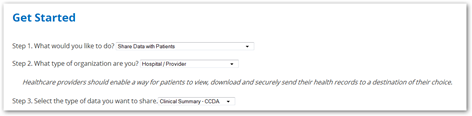
There’s a nice drop down menu to make your selections to put you into the area of marketing and additional information that would be applicable to the appropriate organization. 

Again, all you need is people so this is nice start with materials needed to help humans help other humans.  Website looks nice as there’s been quite a bit of work done here. 

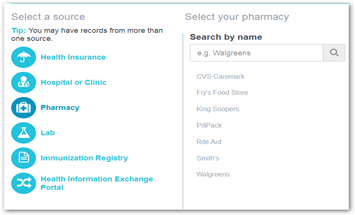
In addition there’s another website and this is to help both consumers and any healthcare entity.  This is called the Blue Button Connector and the intended crowd here is pretty much anyone.  It goes imagethrough with drop down menus where you can get an idea of what insurers, labs, pharmacies  and a few others have available for you in the way of being able to get, view or download your records.  You can see on each filter what’s available and just looking at a few of the menu items, there’s quite a few that could use some additional Blue Button Promotions on their websites I think. 

Blue Button Connector Web Site

In addition there are various apps listed that have been created that make it easier to use the Blue Button that are either free or available at a low cost. 

Blue Button Mobile and Other Apps

If you are a developer there’s additional information at a couple different pages, one is called the Blue Button Plus page.  If you are not a developer you can skip these link as this is where it gets technical:) 

Blue Button Plus Site for Developers

In addition the Blue Button Connector has resources for developers.

Blue Button Connector Developer Resources

I took a short minute to go to Github to look at a few code samples and I didn’t spent a lot of time there but did look at some of the app code loaded and it’s a great start for the libraries. 

Again, all we need is people here for the seniors to give them a hand.  It’s interesting when I have given presentations, you may have all levels of technology in the crowd but again 99% when I ask if they have ever heard of the Blue Button say “what’s that”.  So there’s enough said on the extra human outreach that is needed for seniors, other than directing them to buy a dummied down marketing AARP tablet.  Seniors want to use the same computers and tablets we do and I guess time will tell if it becomes a tool or not.  BD 

Rabu, 17 September 2014

Hospital in Florida Reports Third Data Breach In Two Years…

This appears from what I have read to all be internal theft problems, in other words not hackers, insiders stealing records.image  This takes me back to the game called “Data Dealer” where fictitious nurse Mildred wants to earn some extra cash but in this case it’s real. 

Valesco a staffing agency might be the source here of the problems with screening?  It’s hard to say but they sent the letter to patients so it kind of looks that way. 

These are good sized breaches as well and ones to take seriously.  The last breaches were back to back. 

The report was made to HHS and the data was used to file tax returns for some of the patients.  The Feds are now involved with investigating the case.  BD 

video platformvideo managementvideo solutionsvideo player


For the third time in two years, U.S. Health and Human Services records show Aventura Hospital and Medical Center has reported a data breach.

What is more, the start date the latest data breach is exactly one day after a former data breach ended that impacted 2,560 individuals.

There was also a report impacting 948 people from Oct. 1, 2012 to Dec. 31, 2012.

A company called Valesco Ventures sent a letter to Aventura Hospital and Medical Center patients about the most recent case of identify theft.

Valesco "provides hospital staffing and ancillary services" according to the letter dated Sept. 9, 2014.

According to Valesco manager Terry Meadows, M.D., the company was told last May "an employee may have improperly accessed the personal identifying information of a number of patients of Aventura Hospital."

http://www.local10.com/news/aventura-hospital-medical-center-reports-data-breach/28082920

Selasa, 16 September 2014

Tim Cook From Apple Talks Privacy, We All Deserve That Dignity, And Our Product Is Not You..

He stated we have right to be worried and to be concerned and the companies should be very transparent.  He says it’s going to be a very key topic and of course it’s been a key topic at the Medical Quack for 3 years and counting now as I predicted all this, just following the data and money, and thinking like jerk programmer would do.  I wrote earlier that this is a good time to really look at getting a law to license data sellers, as how do you know who they are? 

Apple Updates HealthKit Privacy Policies–Could Be A Good Time to Also Embrace Support For the Government to License All Data Sellers, Apple Will Be Conducting “Due Diligence” With Those Writing Apps For the Platform As Part of Their Business

The video below is a clip of the Charlie Rose interview part 2, where he talks about privacy.  He states that Apple’s business is not collecting data but rather about selling hardware and software.   Before the event it was on the web that Apple was talking to insurers and oh boy that’s the last thing we want there with any collaboration there with writing any kind of code or software.   Everyone agrees on that one as we are living with their data quantitated models that are not working anymore with insurers, same problem hedge funds are having today with not being able to create a model to return desired profits. 

Apple In Talks With Insurers Now Relative to Healthkit? If So We’re Going The Other Way As Consumers Are Waking Up to the US Data Selling Epidemic Along With Profit Making Algorithms That Generate “Secret Consumer Scores” That Benefit Corporations - A Big Factor With Inequality Acceleration

After the Healthkit information and the watch, we kind of all know that people don’t work that way and look how long it took tablets to catch on, long time as I was a tablet user from way back but it was the Ipad Model that had everything take off.  So there you go with models and the watch may or may not do it and time will tell but for gosh sakes I hope quantitated selves can at least put a partial gag on themselves realize we are not all like them:)  It was said too at the big Stanford MedX meeting too that wellness does not depend on apps and wearables and that it more or less caters to curiosity which I feel is a very true statement. 

So yes it’s time for another little pretty please to help me out with my project of working on Congress (click on picture above)  to pass a law that will require all data sellers to buy a license and disclose to consumers what kind of data they sell and to who, it won’t stop it.  With all the repackaging of data going on today, the flaws are growing and this is dangers and now the internet is giving people a “flawed diagnosis” and you can’t trace it back once you have been flipped a few times and someone’s going to believe that data is truthful, all for the sake of banks and companies making billions selling data, i.e. Walgreens makes 1-2 billion a year selling data and that’s just one company so add in banks, credit cards and billions are flowing to their profit lines while we are stuck with no way to even monitor or fix the flawed data that gets the same price as good data.  We’re screwed and dignity is removed with data selling epidemic.    More about that at the link below.  BD 

Data Brokers Are Now Diagnosing Consumers With Diabetes And Other Chronic Conditions–”Over Rated And Broken Predictive Behavioral Math Models” Providing a Diagnosis That Should Always Be Documented From Your Doctor, Not From The Web

Senin, 15 September 2014

Advocate Health Care and NorthShore Hospital Systems To Merge In Illinois–Creates 11th Larges Non Profit System In the Country

Here we go again as there’s a lot of news of late with mergers and acquisitions in the news today.   If you read theimage news of late this was the worst year that non profit hospitals have had in years so we might see more of these.  I read around the web about folks talking about the different medical records systems and actually they could all use a product and integrate their records today from Zoeticx.  This is a big deal when mergers happen today as medical record integration is on everyone’s mind.  At any rate, I read where there are 3 different systems, Epic, Cerner and AllScripts involved and one platform could unite them all and the Allscripts hospital can buy it right off the Allscripts website to get started. 

Zoeticx–EHR Agnostic Clarity Healthcare Platform, An HIE Requiring No Data Warehousing For Interoperability, Answers The Call for Less Disruption With Actionable Medical Information Flow

One does begin to wonder what’s going to happen when all the mergers and acquisitions are done.  In the rural parts of the US we have had so many of those close as they have run out of money so all hospitals are not created equal today by any means.  BD 


Two of Chicago's largest hospital systems on Thursday approved plans to combine, creating a 16-hospital, $6.8 billion system that promises to change the competitive landscape of health care in the Chicago region.

Advocate Health Care, the state's largest hospital system, and NorthShore University HealthSystem, the dominant hospital chain in the North Shore suburbs, said Thursday they will merge to create Advocate NorthShore Health Partners in a deal that's expected to close in early 2015.

The blockbuster deal is the largest hospital merger in Illinois in recent years, a trend set in motion by the federal Affordable Care Act and fueled in part by declining hospital patient volume and tighter finances.

It will create the 11th-largest nonprofit health system in the country and by the far the largest in Illinois, with more than 45,000 employees and 4,438 hospital beds.

http://www.chicagotribune.com/business/ct-advocate-north-shore-0912-biz-20140912-story.html#page=1

Minggu, 14 September 2014

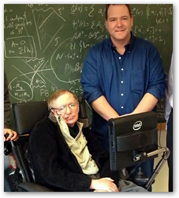
Stephen Hawking and Intel Develop The Intel IoT (Internet of Things) Connected Wheelchair–Video

Now this is a cool video and something very neat a nice break away from Intel’s wearables campaign.  The wheelchair imagealso does biometrical information collection from the user, as well as mechanical information from the machine.  The team also built an application that allows wheelchair users to map and rate the accessibility of locations, and that’s would really be helpful for the wheelchair user to know ahead of time whether or not they would have access or if the wheelchair can handle it.

They could not have chosen anyone better than Stephen Hawking, the world famous physicist and this has to improve his quality of life a bit even though he’s pretty limited.   He cannot walk, or speak and move independently. 

He suffers from ALS and was diagnosed at a young age and was told he didn’t have many years to live but he’s still here with us many years later.  He’s been using speech technology to communicate for years.  There’s a small sensor on his glasses that helps him with his voice technology with his cheek muscles.  It’s just amazing he just keeps going.  BD 


“The Internet of Things can help change lives,” Krzanich said as he introduced a powerful video starring Stephen Hawking speaking from an IoT-connected wheelchair designed at Intel.  Hawking went on to describe how the Intel technology-based machine can increase mobility.

Through the Intel Collaborators program, a team of Intel engineering interns designed a custom platform that can transform standard wheelchairs into data-driven, connected machines. Using the Intel Galileo board and Intel Gateway Solutions for IoT, the team created a wheelchair that enables the collection of biometrical information from the user, as well as mechanical information from the machine, that can then be analyzed by stakeholders in the industry. The team also built an application that allows wheelchair users to map and rate the accessibility of locations, further enhancing the user experience.

http://blogs.intel.com/iot/2014/09/intel-iot-wheelchair-featured-idf14-opening-keynote/

Sabtu, 13 September 2014

Data Brokers Are Now Diagnosing Consumers With Diabetes And Other Chronic Conditions–”Over Rated And Broken Predictive Behavioral Math Models” Providing a Diagnosis That Should Always Be Documented From Your Doctor, Not From The Web

This article calls it “data repackaging” and I have had another name for it, “data flipping” but it’s all the same thing.  Referenced here is Senator Rockefeller and he’s on I have hounded for a couple of years to get on this and pass a law requiring an index of all data sellers, which would require licensing and disclosure of what kind of data they sell and to who.  You need an index #1 before anything else can happen and I’ve been writing about that fact for 3 years but non data mechanics logic folks can’t get that “fact” through their heads and thus it goes on and on and on.  What if we had stock brokers running around with no licenses and heck I even have to get a license to catch a little fish that has virtually no risk involved for me.

Fast of the matter here is they are getting sloppy with their mailing lists and data and let me tell you, flawed data gets the same price as accurate data so there’s nothing to create any reason for them to be responsible at all as that’s just over head.  It’s truly a sad state of affairs that these bottom feeders can’t even a bit of integrity to the data they sell, as again they don’t care.  Want to get into wearables, well think again until this is resolved if you like privacy as the FTC found 7 of them selling your data and they have not named who they are. 

Senator Schumer of New York Calling for Privacy Protections With Sharing Data From Wearable Devices, As FTC Found Some Are Sending Data To 3rd Parties, Once Again Need To License the Data Sellers & Distributors

I have had my issues with flawed data and if you read the link above Acxiom on day tried to tweet with me and I tweeted back politely with facts.  I have been on my own time working on this for 3 years and my readers here know it and get beat over the head about it.  Three years ago when proclaimed this an epidemic folks thought I was crazy but I use data mechanics logic and I’m ahead of everyone, not a talent per se, I just visualize using my former development coding writing and sales ability combined and I figure it out almost every time. 

So here’s the campaign for privacy and transparency if you can kick in a few bucks, that would be great as I’m a couple years into this already and I do update what I’m doing, did one one today.  Nothing will work until we do step one and that is to identify who we want to regulate.  At the campaign link there are links that tell you both about insurers buying your credit card data and some real details about how they record and analyze your voice at their call centers, which becomes yet one more item about you that they could potentially sell.

Guess what, insurers love this data too and I have heard from friends they get letters and do not have diabetes that begin with “now that you have been diagnosed with diabetes” …and that’s not right.  Granted we need the awareness and it’s out there but we don’t need flawed data doing a diagnosis.  You’ll get scored and denied something based on this flawed data, happens all the time and it’s on your dime to fix the data that the sellers made millions distributing.

Data Selling and the Direct Correlation To Accelerated Inequality - Epidemic Spreading Like A Virus Moving Money Keeping Corporations Cash Rich and Consumers Cash Poor

This is the biggest racket around as they all want to make their millions and billions and then it comes back to us, the consumer to prove our innocence of whatever nonsense their data for profit lists.  Again all these non data mechanic logic folks have been just swimming in this with goofy perceptions on how take action and I’m tired of it as they do nothing except wish for some Algo Fairies to come along and save the day..duh?  Here’s a little example of one of my posts being read by Senator Warren’s office. 

Not only that but the data brokers get off easy if they can’t pay their fine, like this one who was fined $1 million but had it cut back to $60,000.00 as the fine would put him out of business and he couldn’t afford it, well I say fine to the second option by all means.  One less out there selling flawed data is great for consumers.

Two Data Brokers Get Fined by the FTC For Non Compliance, One Gets Most All Of The Million Dollar Fine Reduced as They Could Not Afford To Pay By the Court, But If You Are A Consumer With Medical Bills You Go To Bankruptcy Court..

60 Minutes videos will fill you in as well about this nasty business that hurts consumers.

60 Minutes Blasts The Data Sellers, FTC Admits They Have Lost Control - Time To License and Excise Tax “ALL” Data Sellers, Banks, Companies, Etc. - Congress Needs to Act On This…

So what, forget going to the doctor and let the internet diagnose you now with all these so called predictive analytics, no thanks!  Time to license and index all data sellers so we know who they are!  Once you’re done here, take a visit over to Healthgrades and Vitals and see if you can find a “dead doctor” or one with flawed data over there to make an appointment with.  Three links below will give you some good insight there on how flawed their data is.  BD  

Doctors With Serious Sanctions Running Clinical Trials in the US And Sites Such As Healthgrades and Vitals Show No Sanctions at All So You Can Get Fooled Easily
Top Doctor For Miami VA Healthcare System Lost Medical License in New York, Had Issues With Florida Board of Medicine, But On the Internet He Still Works and Takes New Patients in New York With Plenty of Insurers…
Operation Spinal Cap-Former Owner of Orthopedic Hospital Admits He Bribed California State Senator Calderon-Hospital Closed And Sold But Still Listed on Healthgrades


NEW YORK — Dan Abate doesn't have diabetes nor is he aware of any obvious link to the disease. Try telling that to data miners.

The 42-year-old information technology worker's name recently showed up in a database of millions of people with "diabetes interest" sold by Acxiom Corp., one of the world's biggest data brokers. One buyer, data reseller Exact Data, posted Abate's name and address online, along with 100 others, under the header Sample Diabetes Mailing List. It's just one of hundreds of medical databases up for sale to marketers.

In a year when former National Security Agency contractor Edward Snowden's revelations about the collection of United States phone data have sparked privacy fears, data miners have been quietly using their tools to peek into America's medicine cabinets. Tapping social media, health-related phone apps and medical websites, data aggregators are scooping up bits and pieces of tens of millions of Americans' medical histories. Even a purchase at the pharmacy can land a shopper on a health list.

"People would be shocked if they knew they were on some of these lists," said Pam Dixon, president of the non-profit advocacy group World Privacy Forum, who has testified before Congress on the data broker industry. "Yet millions are."

They're showing up in directories with names like "Suffering Seniors" or "Aching and Ailing," according to a Bloomberg review of this little known corner of the data mining industry. Other lists are categorized by diagnosis, including groupings of 2.3 million cancer patients, 14 million depression sufferers and 600,000 homes where a child or other member of the household has autism or attention deficit disorder.

"It is outrageous and unfair to consumers that companies profiting off the collection and sale of individuals' health information operate behind a veil of secrecy," said Sen. Jay Rockefeller, D-W.Va. "Consumers deserve to know who is profiting."

Exact Data's Chief Executive Officer Larry Organ said the list posted on its website shouldn't have included last names and street addresses, and the company has since deleted any identifiable information. He said the data came from Acxiom and Exact Data was reselling it.

http://www.scnow.com/news/business/consumer/article_87a6d21e-39df-11e4-81ea-001a4bcf6878.html

Jumat, 12 September 2014

European Brain Project Turning Into A “Brain Wreck”, An Expensive Database Management Program, Just Hunting New Computing Architectures As Neuroscience and Technology Not Working Well Together

Neuroscientists who initially supported the HBP feel that they have been taken advantage of with this project and can’t determine if there’s going to be any value found here.  You can read a portion of the report in Nature below or use the link and read timagehe entire article.  One option to save the project would be to eliminate neuroscience from the Brain project and just focus on technological objectives. 

Secondly they could split the focuses of neuroscience and technology  into separate sections.  Their last option mentioned here would be to attempt to put the entire project back on track which means funding again and to try to revive trust in the project and involve additional neuroscience entities. 

This project gave birth to the US Brain Project which focuses on techniques development, only one element so if the European project is having this kind of difficulty what does that say for what the US is doing here?  The Neuroscientists feel this took advantage of them and again it became bad model with a bunch of data on servers to maintain. 

Are these folks not well enough attached to reality here?  The European Board announced plans to dissolve the cognitive-neuroscience program.  18 principal investigators left as well as the director.  All they are left with is again a massive data base limited to numerical simulations and by themselves yield no understanding.  So I think we need to keep a close eye on the US Brain Project at this point and not saying there won’t be any value at all, but rather to watch and see if “value” can be created and if they can get the models right. If the European project is not restructured it looks like they have a waste of money on hand.   BD 


Launched in October 2013, the Human Brain Project (HBP) was sold by charismatic neurobiologist Henry Markram as a bold new path towards understanding the brain, treating neurological diseases and building information technology. It is one of two 'flagship' proposals funded by the European Commission's Future and Emerging Technologies programme (see go.nature.com/icotmi). Selected after a multiyear competition, the project seemed like an exciting opportunity to bring together neuroscience and IT to generate practical applications for health and medicine (see go.nature.com/2eocv8).

Contrary to public assumptions that the HBP would generate knowledge about how the brain works, the project is turning into an expensive database-management project with a hunt for new computing architectures. In recent months, the HBP executive board revealed plans to drastically reduce its experimental and cognitive neuroscience arm, provoking wrath in the European neuroscience community.

The crisis culminated with an open letter from neuroscientists (including one of us, G.L.) to the European Commission on 7 July 2014 (see www.neurofuture.eu), which has now gathered more than 750 signatures. Many signatories are scientists in experimental and theoretical fields, and the list includes former HBP participants. The letter incorporates a pledge of non-participation in a planned call for 'partnering projects' that must raise about half of the HBP's total funding. This pledge could seriously lower the quality of the project's final output and leave the planned databases empty.

The HBP blends two styles. One comes from a history of successful interdisciplinary collaborations in the European Union in brain- and neuron-inspired computation1. The second originates from a computational research programme, the Blue Brain Project2, initiated by Markram in 2005 (see 'Brain activity'). This collaboration between the Swiss Federal Institute of Technology in Lausanne (EPFL) and the IBM computing corporation aimed to build large-scale 'bottom up' numerical simulations of a rat's neocortical column, a set of about 100,000 neurons considered to be a functional unit within the brain.

The crisis results mainly from ambiguities concerning the place of neuroscience in the HBP. From the beginning, neuroscientists pointed out that large-scale simulations make little sense unless constrained by data, and used to test precise hypotheses. In fact, we lack, among other resources, a detailed 'connectome', a map of connections between neurons within and across brain areas3 that could guide simulations. There is no unified format for building functional databases or for annotating data sets that encompass data collected under varying conditions. Most importantly, there are no formulated biological hypotheses for these simulations to test4.

Many scientists also feared that the HBP would siphon funds from fundamental research. The European Commission's investment in a large 'brain project' would influence what other research areas it chooses to fund. Nonetheless, such an opportunity seemed unlikely to arise again, and neuroscientists (ourselves included) joined up, even if they did not agree with all aspects of the HBP proposal or with certain promises used to sell it. We put our faith in open and interdisciplinary collaboration, trusting that intellectual and operational details would take shape gradually and collectively.

Neuroscience in the HBP is now limited mainly to simulations and to building a massive infrastructure to process mostly existing data. The revised plan advances a concept in which in silico experimentation becomes a “foundational methodology for understanding the brain”5. Numerical simulations and 'big data'6 are essential in modern science, but they do not alone yield understanding. Building a massive database to feed simulations without corrective loops between hypotheses and experimental tests seems, at best, a waste of time and money. The HBP's goals now look like a costly expansion of the Blue Brain Project, without any further evidence that it can produce fundamental insights.

http://www.nature.com/news/neuroscience-where-is-the-brain-in-the-human-brain-project-1.15803

Zoeticx–EHR Agnostic Clarity Healthcare Platform, An HIE Requiring No Data Warehousing For Interoperability, Answers The Call for Less Disruption With Actionable Medical Information Flow

Here’s yet another update on what Zoeticx is doing with their Clarity Server based platform.  We all know and talk about how imageHIEs are expensive, take a lot of time to build and then of course the cost of sustaining them long term.  Zoeticx has different plan that allows for interoperability of EMRs to work without that burden.  You would have to be living under a rock today to not be hearing about the focus of interoperability today.  There’s a a few other cloud platforms in the works or a few that are working but they too again require synchronization of the medical records of those participating. 
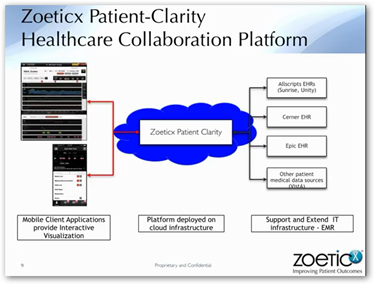
What doctors are calling for today is “less disruption” and the video below is an explanation from Dr. Don Voltz on how Zoeticx answers those issues.  When interoperability works and records are shared, that’s a good thing and we have some of that happening across the US but it’s not everywhere, which is the goal of all hospitals, doctors, being able to collaborate and share medical records.  So far Zoeticx has built 4 applications to work on their Clarity server and has APIs built for Allscripts, Epic and a java based API. 

Allscripts has a page on their application “store” to where you can explore more about how Zoeticx would sit top of their medical records system.  Again, Zoeticx just needs the API created and any medical records system can use the platform.   So basically anyone with Allscripts or Epic has the API built and ready to go, and then can build any other web applications t go along with the basic interoperability apps that are already included.  Apps for the Ipad and IPhone are available for download at the ITunes store and of course they are not going to do anything until they are configured to work with a Zoeticx server but they are readily available. 

The four apps already designed to work on Zoeticx include CareIntelligence, CareSynergy, CareCompliance and CareHistory and you can read about them on the website with descriptions of how they work with the Zoeticx Clarity Server.  What you can see in the video is the nice common user imageinterface created at each end with using an inpatient/outpatient collaboration as an example.  If if an physician is a “lagger” and doesn’t have a medical records system yet, they can still have a “registered” device and collaborate and actually that’s not a bad thing as it could motivate them to maybe be even move from paper records a little sooner too.  

The company also has a proposed ONC 3-6 year timeline and as they state, “it’s available now” to get started.  I agree with them on leaving out the 10 year roadmap as it’s just too far to be able to predict as technology rules that today and just look at how fast Meaningful Use changed and the number of changes, etc. that had to take place there in a short time, so yeah, 10 years, we can’t get there quite yet.  The link below has some additional information, videos and a further explanation on how Zoeticx works.  I’m writing about this as I’m looking at money and the savings here with not having to build more warehouses to sustain data to allow collaboration is staggering.  From what I am reading here this could hook up and connect the DOD and VA too, no matter what level they are at with current legacy systems or adding new modules or medical records system and could sit there and allow collaboration while what ever they decide to do occurs, in other words interoperability  opens up while other work in progress takes place.  Clarity server is not new and as a matter of fact several Epic users have one, like Kaiser that works with their medical records systems to provide reporting services and and synchronization of data.  You can can search that out and see what Kaiser has done with developing their Clarity server but again it still has to synch with their configuration, so again we come back to this is wimagehat makes Zoeticx unique. 

Zoeticx Clarity Server - Middleware HIE Will Save Millions Maybe Billions With HIE And Has 3-6 Year ONC Compatible Time Line, Works Using APIs, Web Apps Where Nobody Has to Swap Out Their EHR…

I keep reading about interoperability and the involvement of Congress and I don’t think they really get the entire picture at times, but that’s no unusual or unique either as I think we could discuss that matter all day but the idea here is to take the interoperability chore from the medical records and kick it up to a platform.  Sure there’s been a lot of work with being able to create continuity of care documents and more and those are good things too by all means and are used but I have read too where most medical records can produce them, but others have issues importing them and thus so we come up with “EMRs that do not allow interoperability” in the terminology we hear out there.  It’s not usually the “bad guy” medical records system doing this on purpose as there’s a lot of time that goes into writing code but like anything else it’s getting different data sets, mapping and coding to work with each other.  There’s no “bad guy” EMRs out there doing this on purpose, it’s the data world and you can reflect back on Healthcare.Gov if you want talk about data sets, code and interoperability as there’s a lot there that’s not fixed and all working as the “perception” was created. 

Here’s a couple words from Zoeticx:

  1. Medical professionals have seen too many disruptions to their environments. Bottom line is imagethat none of the disruption has proven to improve patient outcomes.
  2. What they are facing is that the same old problems with worse than paper environment – in that, at least the paper environment is what they have been accustomed to.
  3. Healthcare IT fails medical professionals – namely in the most important tasks – EHR interoperability. With that, professionals see the upcoming struggles with more disruptions but no light of a real true solution.

HIE is not the solution for interoperability. Adding additional database layers, creating more interfaces, point solutions are not the outcomes for professional. They want some simple things:

  1. Medical information flow – make patient medical information accessible
  2. Target notification – make the system smart where care providers get informed about condition change for treatment instead of continuous manual polling for data
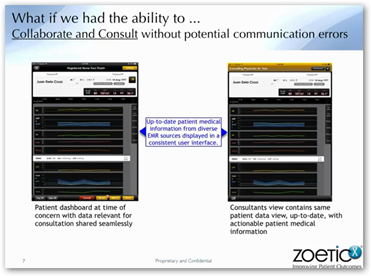
  3. Collaboration – let me consult, securely, effectively, and with no concern on miscommunication
  4. Automation – let me focus on medicine and help me automate the tracking / completion of tasks

I sit here every day, and being a very early medical records developer who quit when all went to the web and look at what’s going on out there with the big picture and I’m seeing a lot of proof of concepts falling on their face as we seem to have this big “data grab” going on out there and maybe missing the point of the word “relevant”, in other words what kind of data, and where do you need it to collaborate and make good solid clinical decisions?  I think that’s a good question for all to ponder here and there as you can flood yourself on data overload and software and jumble up a good system if your are not careful.  It’s hard and not easy to create user friendly interfaces today as well, as that too gets to be complex and Zoeticximage seems to have answered that issue with the same user interface on an Ipad appearing on both side, so everyone sees the same thing, that’s huge value right there.  We’ll still have various medical records system out there for years but when it comes time to collaborate and give good patient care, the same interface and data is seen at both ends and to me that’s a big deal and I’m sure there’s some real appreciation from doctors with this point as well.
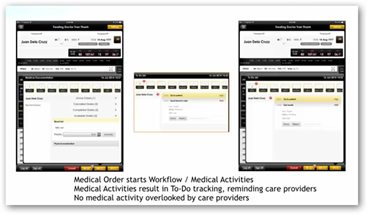
The video is from Dr. Don Voltz as seen through his eyes in telling you where he sees the value and how it can give value to his workflow.  Be sure you have a little bit of time to watch the entire video as it runs a bit over 28 minutes. Again you see workflow and the timely ability to take action on patient care.  There’s no duplication of data and the connection the back end of the data bases is the key that keeps the cost down and the system functioning efficiently.  The platform can be provided on both mobile and on desktop systems.  Information is not lost or missed with a consistent interface that will help with reducing errors.  Care providers can build teams and determine who will be accountable in which areas and again all members can be updated.  This is important as how many times have we discussed “patient handoff” with teams and something getting missed. 

A primary care physician would be able to follow the history and care of a patient while hospitalized for their care, even though not directly involved in some of the decision making at the hospital, in other words the primary care MD is not left in the dark.  That’s a big deal as sometimesimage the Primary Care doctor is the last one to know that a patient has been admitted to the hospital, and I have heard that on many occasions from doctors first hand. 
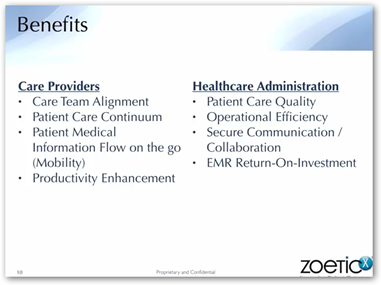
Again the value here too is the fact that Zoeticx sits on any medical records system and it can save doctors a ton of money without having to rip and replace their current medical records system.  The ideal configuration would be the server in place at a hospital with all the devices, EMR Gateways in place to allow for interoperability. Doctors in private practice today who maybe were early investors with medical records are all pondering, do I need to upgrade to interoperate and spend more money?  Well with the Zoeticx platform that allows for some flexibility there with such decisions and all might be able to just keep their current systems if they are indeed doing what is needed and required.  Moving up to a platform takes a huge burden of interoperability off the shoulders of medical record vendors as well.

Also you see a hospital that may have one EMR vendor system in the ER, but the rest of the hospital uses another system, so again what a great way to marry the two in house as well as building the rest of the interoperability to communicate with other hospitals and doctors.  Again the design here with the Zoeticx Clarity server is what is unique out there with eliminating the expense of building more data warehouses, and yet allows for true collaboration of physicians and doctors anywhere. There’s a lot of specialty medical records systems out there too, like ones for Oncology and Google just tossed some money at one of them and so how do these fit in the over all medical records scheme?  Well if you have a platform, they can fit in just fine to collaborate with an API written.  Hey Larry Page, tune in here with your acquisition of Altos Oncology solutions via Flatiron (see link below:) 

Google Ventures Invests $130 Million Into Health Technology Company Flatiron, Yet One More MD Decision Assisting Platform and Back Doors It Into the Medical Records Business As Flatiron Will Acquire Altos Oncology Solutions

The saving this creates is huge and when I think of what my tax dollars are going for with the VA and DOD and their systems, well they should at least give this a look themselves.  I have seen the extensive work both agencies have done in Hawaii with a common dashboard and there’s a lot to be said for all that time and effort as well.  Sometimes folks get the impression that the VA and DOD are sitting on their hands, and that’s not the truth at all.  So again I would think they too would want to take a look at Zoeticx and they are all in the same quest to save money and provide better collaborated clinical care for patients.  BD

https://www.youtube.com/watch?v=mu9scdsbmmc

Rabu, 10 September 2014

Apple Gave Us Yet One More Day of “Quantitated Madness”–More Proof of Concept Models And Software Thrusting “Virtual Values” Into a “Real World” Where “People Don’t Work That Way”…

Well yesterday came and left and I have been reading over and over that the life of most mHealth apps is around two weeks, so look at the money spent on all of this again and you come back to square one with pushing models on humans they don’t want and few have interest in.  It’s all about making money and there’s nothing wrong with that as we all need a certain amount of money to survive but what I saw yesterday was yet one more example of how “virtual” things have become. We hear over and over how all of the devices are going to make things better but instead we have a world of consumers just “pounded” with marketing as companies have spent a lot of money and when they find out “people don’t work that way” here comes the marketing to “force people to work that way” and I saw a lot of that yesterday.  Apple is not alone, it’s all around you and when people don’t buy, out comes the marketing, fake studies and skewed numbers to “make you believe” that everything out there will make your life better.

The truth is not always such.  As a matter of fact there’s a lot of irritation to most of this as we see our “Algo Duped” Congress who can’t do little anymore as things have gone over most of their heads and some are zoned out into the same “virtual” values that do little for the real world.   This is very difficult indeed for doctors as they have to deal with the “real” world every day, patients, and they too have to balance the somewhat nutty technology we see and find what makes sense. 

So now that companies have all spent these ghastly amounts of money on some broken models, what’s left?  We can look forward to more data selling, more expense with non relevant data being used and of course we pay for all of this as well.   Because of all the money spent creating queries and software though, it’s going to be forced upon us to go against the grain of the “real” world and buy in to all of this and we will continue to see one failure after another as our society gets angrier as with time and more failed models, the Algo Duping becomes more apparent.  I’m not saying it’s all bad by any means and there’s some really neat stuff going on as well but so much of it gets back burnered anymore as the “junk” hops out in front.  I used to write software and thus I have some real admirations for talented people who do create great solutions too, but again that’s not what makes top line news today. 

“People Don’t Work That Way” A World of Broken Software Models That Don’t Align To the Human Side,Too Much Push At Times With Only A Proof of Concept That Fails in the Real World..

The larger iPhone I see as a real world type solution of course as who doesn’t want more screen real estate?  Everyone wants that so there was one answer from Apple that maintained a response to the “real world” desires.  A new operating system as well was introduced and that’s just part of business today and the ability for more developers to write more apps, well we get both with that option as well, more good stuff and more nonsense.  I do miss the days when big corporations maintained the “nonsense” in house and we didn’t have to hear about it until there was a pretty good chance of a a decent, usable product or service coming out.  Today we have to listen to every tiny bit of nonsense software, many of which right from the start are a “proof of concept” that’s going to fail or is written to be a “duper” to collect more consumer data to sell.

In essence, yesterday Apple just became a bit more virtual with the “watch” and the idea that we are just climbing the walls for mHealth apps.  Sure they have spent a lot of money as have many others and there are good professional mHealth apps that doctors use, many FDA approved as well, but we get the quantitated “junk” mostly and I didn’t see yesterday as being anything different.  If you are thinking the mHealth devices and apps are ready for EMR integration, well think again because that too is a long lengthy and costly road.  Wake up to the reality here. 

Of course anyone in the Health IT business knows that if anyone can or wants to do anything, it’s Dr. Halamka at Harvard Medical and I just head his post and guess what, that’s exactly where we go with all of this.  Of course we all rely on his viewpoints and expertise and yesterday was no different as he wrote he spent time using the technology…

“Apple created an enormous white pavilion next to the Flint Center for the demonstration of these products.  I spent the afternoon using the technology they announced.

Recently, a donor committed significant funds to the development on an app that will do just that.    We hope to have a running prototype in 2015.”

We don’t know who the donor is but read his comments and someone’s paying a lot of money for an app to be developed that “could” work with EMRS.  As I always say, “the short order computer code kitchen burned down years ago and there was no fire sale”. 

Dr. Halamka seems to agree with exactly what I have been saying for a long time too, the answer is “middleware” and this is the case here too. Keep in mind he’s also looking at a lot of this for the first time and you know what’s going on as far as structure until you dig in to the code here.

So anyway, you can dream on for a while and I hope we get something worthwhile from Harvard as Dr. Halamka is always hands on and not marketing more “quantitated madness” for what he says and does, unlike the rest of what you see out there.  We are already seeing a great deal of non relevant software and analytics just being pushed in our faces constantly and the “dream of the sexy job” of being a data scientist.  One some of that you can almost laugh on if you understand some of their math and the number dupes that occur.  Scroll down and watch video #1 in my footer if you want more on that and how we all get duped over and over and over again with numbers.  That’s not going to stop any time soon either as “duping” is very profitable until the model just falls on it’s face and won’t work anymore with the arrays of data, subprime anyone? 

How Long Before the Data Scientist Demand Begins To Slow? About Half of the Analytics Investments Will Be A Wasted Investment As Some Data Will Prove To Be Non-Relevant to Solving “Real World” Situations At Hand

Dr. Halamka also stated it has become a war with security and his job as a CIO of course is going focus more on that as a priority while the the little watch project will fall in somewhere down the line.  We need security with medical records, the little watch is an option that’s going to cost money as well so it has to take it’s place of being a virtual value as we work in the “real world”.  

It’s Become A War To Keep Patient Medical Records Secure And Out of the Hands of Hackers, Data Selling Epidemic in the US Fuels This Fire…

Ok so now that the virtual nonsense of the watch and Apple Pay is done we can get back to the real world today and go about our business and hopefully we may have learned one more thing from yesterday, be a skeptic when you need to be.  Here’s a great essay written by a quant on that topic who does models and has for years.  We are living in “Duper Ville” at times and the key is to figure out what’s a real world value and what’s virtual and ask “am I being duped” again. 

I’m not specifically attacking Apple by the way at all but rather just addressing their contributions to the world of some additional confusion for consumers in graying out virtual versus real world values and we had a bunch of that yesterday, it’s a real problem today as even our White House puts out emails with “junk science” numbers posted that nobody can predict, so there’s a ton folks in government that are duped as well, and that’s really the scary part as they become more virtual being duped and corporations and banks run more of the country. 

“On Being a Data Skeptic- Modelers Have A Bigger Responsibility Now Than Ever Before”–A Must Read Essay, Start “Sniffing the Data”…

The credit card people too were excited too yesterday as more you use that credit card, the more data they get to sell and I wrote about that last year as a warning as Master Card was bragging about what they are doing today and how profitable their data selling ecommerce was going to be, yup, selling our transaction data. 

MasterCard Recruiting Software Engineers For New e-Commerce Technology Lab, Maybe More Slicing and Dicing of Our Data To Sell to Insurance Companies for One? Be Wary of Corporate “Algo Dupers” Out There Feeding on “Nonskeptical Consumers”…

If you want to know more about how this works, visit the Killer Algorithms page where people smarter than me explain some of this for you as it’s not going away anytime soon as long as folks in the virtual worlds can come out and harvest some real world values and make billions.  BD

Attack of the Killer Algorithms – “Algo Duping 101″

Selasa, 09 September 2014

Here’s Comes the Next Algo Duping Nonsense In the Name of Privacy–Software To Allow Users to Sell Their Personal Data for a Pittance, You’re Just Being Flat Out “Code Hosed” Here…

I read this article and absolutely had to laugh at the marketing here.  If this isn’t “code hosing” I don’t know what is:)  This is nothing more than a few companies that want a cut off of your personal data.  Be aware of the hosing going on out there by all means.  Selling imageyour data yourself is a joke and is nothing compared to the millions and billions made by banks and corporations selling your data.  It’s just a way to use a model to have you say “it’s ok”and give you some chump change to continue to violate your privacy.  I do give them a few points for imagination and even Google at one point entertained this idea.  I sure do miss the days when nonsense like this was contained in enterprise development as we didn’t have to see and deal with all this nonsense.

The answer to transparency is still to get a law passed to require all data distributors to buy a license as this still evades the issue of not knowing who they all are.  I tried one of them that was supposed to alert me to folks collecting data and they can’t get it right and warn me that Blogger has data on me.  Well of course Blogger has data on me as my blog has been there for 7 years, duh?  This really is just another code hose that resembles what goes on with the markets with having one algorithms go search out others and take executed actions.  It’s ridiculous.  These are just some little start ups that want to make a buck.

Just stop being duped if you can and take in some videos at the Killer Algorithms page and see what this is all about. 

Attack of the Killer Algorithms – “Algo Duping 101"

Read this link if you want as I included some tweets where I seemed to get Acxiom a little moved.  Just don’t fall for this crap as you are being code hosed if you do.  The Senator was correct at 7 apps/devices were found by the FTC to be selling your data. 

Senator Schumer of New York Calling for Privacy Protections With Sharing Data From Wearable Devices, As FTC Found Some Are Sending Data To 3rd Parties, Once Again Need To License the Data Sellers & Distributors

Nobody except myself seems to want to mention the direct correlation with the data selling epidemic to inequality but you can read the link below and I spell it out there.  If there’s wasn’t all this money in it, there would not be a problem first of all.  Second of all insurers and others buy up all and any kind of data they can get a hold of. Insurers are already buying your charge card records and are recording your voice on the phone at call centers to see what your current state is.

Data Selling and the Direct Correlation To Accelerated Inequality - Epidemic Spreading Like A Virus Moving Money Keeping Corporations Cash Rich and Consumers Cash Poor

Help me out if you like and donate a dollar or two to get a law passed to require all data distributors to be licensed so we know who they are and disclose what kind of data they sell and to who.  This won’t stop it but would bring transparency to the forefront.  You might as well forget consumer mHealth as well as people are running for the exits due to all of this.   These companies and what they promise are a joke and don’t fall for this as you are really worth much more than this dummy down algorithmic process by all means.  If you haven’t figured this out yet, this is how the “Secret Scoring of America” is what accelerates inequality.  BD

World Privacy Forum Report - The Scoring of America: How Secret Consumer Scores Threaten Your Privacy and Your Future - One Big Element that Fuels the Continued Attack of Killer Algorithms & Demise of the Middle Class Creating Profiteering And/Or Denial of Access


Our personal information is highly valued, and online data brokers are making millions by gathering and sharing our search histories, buying habits and marriage statuses with advertisers and marketers. But several new services want to help you take control of this process — by selling your personal data yourself.

That's what a new generation of platforms, including Datacoup, Handshake and Meeco, make possible. All three are personal-data marketplaces set to launch this summer, and their goal is the same: to cut out the data-mining middleman by allowing users to share their personal information with companies — and get paid for it.

http://www.npr.org/2014/09/09/346981606/privacy-or-profit-these-firms-want-to-help-you-sell-your-data

Optum Labs Add Four Additional Data Miners To the Collaboration Looking for Data…

If you are not familiar with what Optum Labs is, it functions in Massachusetts where hospitals system like Mayo, McLaren, Dignity and I think a couple more de-identify and send all their medical records system to their labs to where the data is cleaned, formatted, etc. imagefor paying data mining members to use for research, painstakingly looking for information about their drugs or products, in the case of Merck and Boston Scientific or other entities wanting to research for particular conditions, diseases, etc.  When the labs first opened they explained there were two kinds of memberships and the hospitals, such as Mayo are “owners” which means they have an opportunity here to maybe make some money along the way. 

Boston Scientific Joins Optum (United Healthcare) Labs - Research for the Good With Profits Built In For Those Providing Medical Records And Data…

Four new members were added today and these all look like the paying miners from what I am reading, again looking to find something, anything to query to see if they can find some value in the data.  The University of Maryland stated they are looking for information relative to Alzheimer's and healthy aging.  Optum Labs provides the apps for the data mining on their system.  Merck is another new member and of course they are looking for drug information relative t their products. 

UnitedHealthGroup and AARP Get Cozier, AARP Still Gets Paid for Marketing Use of AARP Name As AARP Becomes an Optum Labs Data Selling Promoter Amidst Doctor Complaints Received Relative To United Firing of 5500 MDs–Subsidiary Watch

These are just long tedious data digs and Harvard Medical School HealthCare Policy group is another new member and their focus is education so not exactly sure what they might be digging for other than maybe information for studies as a guess as well as Media Research, another new mining member which is located in Minnesota.

United Healthcare Adds McLaren Care Health System Into the Shared Clarity Data Mining And Selling Venture Along With Dignity Health

They also have Humedica that they paid hundred of millions of dollars for that can kick in here too with selling de-identified patient medical record data.  Humedica will be able to package up the non identified data and sell it to pharmaceutical, device  companies and others. Humedicauses a portal service for the hospital analytics and the information sold from EMR records can show which products are doing better, worse, etc.

This sounds like it’s direct competition for the FDA Sentinel program too as remember back a few years ago when insurers were going to donate claim information to add to the device and drug files that were being gathered to evaluate for safety along with medical records added.  BD

Senin, 08 September 2014

It’s Become A War To Keep Patient Medical Records Secure And Out of the Hands of Hackers, Data Selling Epidemic in the US Fuels This Fire…

We all should know or be aware of the fact that the US has a data addiction and selling problem.  We don’t do as much manufacturing anymore as any company out there with data knows there’s cash burning a hold in the company pocket if they can sell it.  We end up with data being sold to where the end buyer finds out later that what they bought and are trying to use puts no real money to their bottom profit line.  That’s a slow process indeed as people keep hiring data scientists thinking there’s a profit rabbit on every corner to pull out of the hat, which is not true.   imageThese are more of the data novices that really get caught up in all of this as someone selling software can really hype you up on the fact that you need it and thus with that type goes the hacker hype and interest too.

How Long Before the Data Scientist Demand Begins To Slow? About Half of the Analytics Investments Will Be A Wasted Investment As Some Data Will Prove To Be Non-Relevant to Solving “Real World” Situations At Hand

So now we are seeing some of the biggest hospital systems being hacked and how far they get access varies.  Instead of a major focus on security, healthcare prefers to sit around and create data and images to view and say “look how pretty my infographic is”…like on obesity which is very visible and I see it every day but for some reason folks think this needs to be mapped over and over and over. 

The breach at UPMC was pretty bad too and the hospital records of employees were accessed with fake income tax returns filed and bank accounts drained so other than medical records there’s other hacker cash cows they can go after. 

UPMC Medical Center Workers Protesting Low Wages While Investigation of Employee Data Breach Continues With Fake Tax Returns and Bank Accounts Drained..Double Whammy

Instead of all the little silly start up stuff, why doesn’t Silicon Valley put more effort in to this area if they want to be constructive instead of masses of “me too” types of software that end up in the “glut” pools with millions down the drain.  We don’t know who the real data sellers are in the US either so it’s easy enough to confused hackers with real data sellers that are making billions selling our personal data sometimes as Experian found out with not doing enough due diligence on a company they acquired and is still the largest data breach exposure around, 200,000 million US citizens, about two thirds of the US population.   Experian bought a company that had a hacker already built in that the Secret Service found later.  Read the link below for the full story on that breach.  BD 

One Really Good reason to License and Excise Data Sellers, Huge Breach As the “Data Selling Epidemic” Both Legally and Illegally Continues To Grow-All We Have Are Lawyers Who Only Do Verbiage While “Code Runs Hog Ass Wild” -Due Diligence is Dead


Demand for health records is high. The FBI estimates one goes for $50 on the black market, much more than the few dollars often required for credit card numbers. Ponemon Institute, a research center that examines data protections, says breaches cost the industry up to $5.6 billion a year.

Stolen health care data can lead not only to financial loss but also to inaccurate medical records and, thus, misdiagnosis.

These and other recent incidents reveal the growing market for patient data and perilous gaps within the health care industry.

“It’s a war we’re in,” said John Halamka, the chief information officer of Boston-based Beth Israel Deaconess Medical Center and cochair of the Health IT Standards Committee, a federal group that advises the government. “Hackers innovate and find new ways to get in and those who store data innovate and find new ways to keep them out. We’re leapfrogging back and forth.”

Halamka considered this summer’s attack on the hospital operator, Community Health Systems, one of the most sophisticated he’s seen and an example of the increasingly clever methods of cyber criminals.

http://www.bostonglobe.com/news/nation/2014/09/05/health-care-industry-ill-prepared-for-vicious-cyberthreats/ZdvDGaipJi7VSN0TogezkL/story.html